
When it comes to climate change, there are some scientific terms that are thrown around without any explanation and often without context. This isn’t always that helpful. Even with a background in science, it can be easy to misunderstand unfamiliar scientific terms. Also, it isn’t just scientists with a right to know and understand how the world around us is changing, we all have that right.
So, let’s go over ten of the most important climate change terms and what they mean.
1. Global Warming
Global warming refers to the rise in the average surface temperatures of the planet observed during the 20th and 21st century. This is calculated as the difference in the annual temperature (temperature in any given year) to the long-term average, which is usually a 50-year average. This is done to eliminate local variations in climate and to minimise the effect of anomalies caused by, for example, equipment malfunctions.
Temperature is generally reported in degrees Celsius, rather than in Farenheit or Kelvin, as this is the mostly widely used scientific standard measurement. Overall, global warming reached 1.1°C above the 1850-1900 average in the decade of 2010-2019.
2. Climate Change
Climate change refers, specifically, to the effects of recent global warming on the planet’s climate system. As the climate system varies a great deal across the world, the effects of global warming are not uniform. For this reason, scientists make the distinction between global warming and climate change as two separate things. Rising global temperatures make extreme weather events such as hurricanes and heatwaves more common. However, a hurricane is still a localised event that will not affect everywhere on the planet at once.
3. Greenhouse Gases
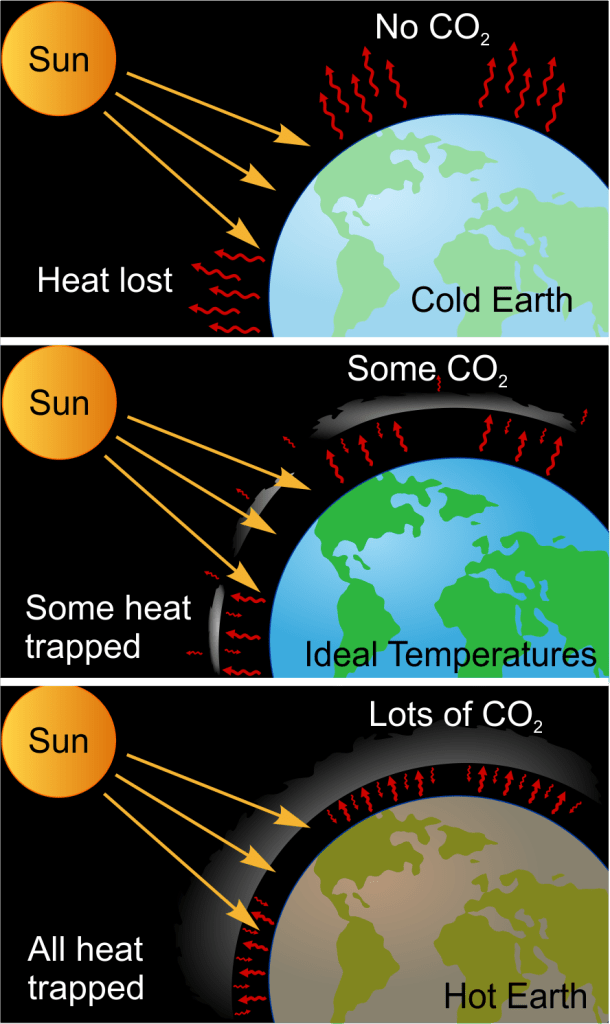
Greenhouse gases are the principal cause of global warming. Greenhouse gases act as insulation, trapping heat which is produced when sunlight hits Earth. The heat trapped by greenhouse gases allows for liquid water to exist on the surface and allows life in the form of animals and plants to exist. However, there can be too much of a good thing and the more greenhouse gases build up in the atmosphere, the hotter the planet gets causing dramatic climate change.
Carbon dioxide and methane are the two most famous greenhouse gases; however, others include nitrous oxide, hydrofluorocarbons, perfluorocarbons and sulphur hexafluoride.
Greenhouse gases are measured either in parts per million (ppm) or parts per thousand (ppt). This refers to how much of the greenhouse gas is in the atmosphere compared to all the other gases that make up the atmosphere. Although greenhouse gases are measured only in very small amounts, they have a disproportionately large effect on global temperatures.
4. Greenhouse Emissions
Greenhouse emissions refer to the release of greenhouse gases, usually through certain human activities. The burning of fossil fuels – coal, oil and gas – releases a lot of greenhouse gases. Chemical production, farming, construction and many other activities also produce greenhouse gases.
Emissions are reported as carbon dioxide equivalent (CO2 eq). As not all greenhouse gases have the same effect on the global temperature, it is better to compare them to a single standard. This makes it less confusing for everyone. As an example, 1 kg of methane works out to be equivalent to 25 kg CO2. When discussing global emissions, the most common unit used is either tonnes or gigatonnes CO2 eq (equivalent).
5. Climate Change Impacts
Climate change impacts are sometimes used interchangeably with climate change itself causing confusion. However, climate change impacts are solely how a changed climate impacts human life. Climate change is the increased number of extreme weather events. The impacts of climate change include the loss of life from the extreme event, the damage to buildings and infrastructure, the damage done to crops and herds, and damage done to our environment.
Climate change is causing some areas to become increasingly hot and dry. The impacts of climate change mean those areas will have less yield from farming, more cases of heatstroke especially among people who work outside, soil degradation and reduced access to water for both animals and humans.
6. Compound Impacts

Compound impacts refer to those impacts which influence each other in addition to climate change. As an example, a drought can cause crops to fail on a large scale. This is a direct impact of climate change. The failed crops then have knock-on effects to the economy and to food security and can drive farmers into poverty. It can affect health as diets become less varied and the stress of the situation affects mental health.
The direct impacts of climate change will cause damage to human society, but it is the compound impacts that spiral on top of those that will be devastating for a huge proportion of the human population.
7. Tipping Points
Tipping points refer to certain conditions within the climate system which, when reached, become effectively irreversible. The biggest and clearest example of this is ice sheet collapse. If the ice sheets over Greenland and Antarctica are lost through climate change, it will take tens of thousands of years for them to reform. This is longer than human society has existed and is therefore considered irreversible.
However, the ice sheets are not the only place where tipping points may be reached. Coral reefs take hundreds of years to grow and require very specific circumstances. A tipping point will see coral reefs die off all over the world with little chance for them to grow again.
A big loss of biodiversity in plants and animals – i.e. a mass extinction event – will likely take millions of years to be resolved as the few species that survive adapt and evolve to fill in the gaps that exist in the ecosystem.
8. Positive Feedbacks
Positive feedback is a cycle within the climate system that, once triggered, will continue to feed itself and will not stop unless something else forces it to. An example of this is the melting of permafrost and the release of methane. Permafrost occurs in high latitude regions that are cold for long portions of the year, such as northern Russia and Siberia. The water in the soil is essentially permanently frozen.
Many permafrost areas don’t just have frozen water trapped into the soil, but frozen methane. As temperatures in permafrost areas increase, the permafrost melts, and methane is released as a gas. This gas enters the atmosphere, where it causes further warming. Further warming means more permafrost melts and more methane is released. This cycle will continue until all the permafrost is melted and all the methane has been released. This is positive feedback.
9. The IPCC
The IPCC is the International Panel for Climate Change. It is an organisation funded by the United Nations whose aims are to investigate and inform the UN on the science behind climate change. The IPCC takes in all the science published on climate and reviews it, assessing the conclusions and the certainty of those conclusions. This science is then condensed into reports that discuss the causes of climate change, the impacts and what needs to be done to avoid the worst impacts. The most recent report, the sixth synthesis report, was released in March 2023.
All the major targets for climate change such as emissions targets are set by the IPCC based on the most up-to-date climate science. Although, individual governments are generally choosing how they want to meet those targets themselves.
10. Net Zero
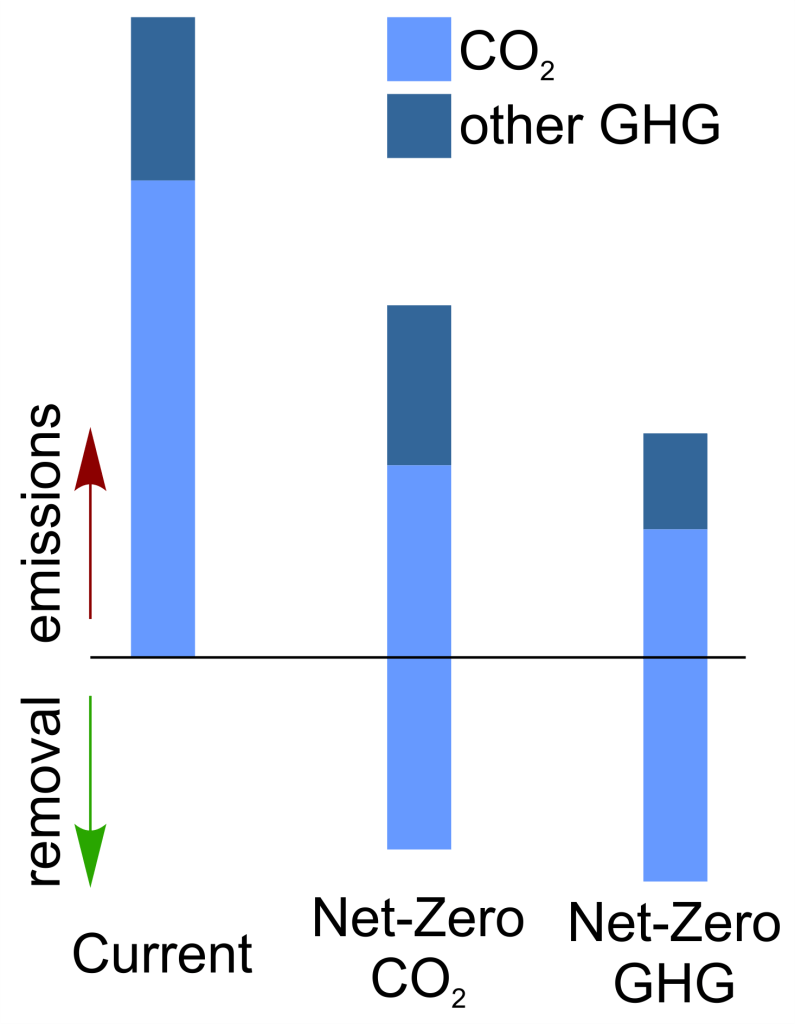
Net zero is the emissions target that the IPCC has put forward as the best way to avoid the worst impacts of climate change. It is split into two different aspects.
Net zero carbon dioxide means that for every tonne of carbon dioxide released into the atmosphere, a tonne of carbon dioxide is removed i.e. carbon dioxide in the atmosphere is neither increasing, nor decreasing. Net zero carbon dioxide is the first major target and the IPCC state that the sooner we reach the target, the better the outcomes.
Net zero greenhouse emissions means that for every tonne of greenhouse gases released, a tonne is removed. Net zero emissions is the target we will need to reach if it takes us too long to reach net zero carbon dioxide, as it will have an overall cooling effect on the climate.
This covers ten important terms in climate science, their meaning and context. Our climate system is complicated and so climate science is complicated too. However, that doesn’t mean it has to be inaccessible. Hopefully, with these terms, the next time you read or hear about climate change you’ll be able to understand just a little better what is happening to our world.


 Rivers of Ice
Leave a reply to Nahid Salman Cancel reply