
The first part of the synthesis report of the International Panel for Climate Change was concerned primarily with where we are right now. It detailed the changes scientists have observed in our climate so far, what impacts those changes have had on human populations and the current mitigation and adaptation policies that exist.
The message was clear: we have made some steps in the right direction, but they were very small steps and much more action is needed if we are to prevent catastrophic climate change.
The second part of the synthesis report ‘Long-Term Climate and Development Futures’ is concerned with where we go from here. What will our future look like if we persist along the same path we are on? What is the best-case scenario, if we act now, and what is the worst case, if we don’t act at all?
As with the first article summarising the IPCC synthesis report (found here), there are five key takeaways from this section.
1. The impacts of climate change are only going to get worse
The IPCC has modeled what impact the changing climate will have on the world, our environment and human health and population going up to 2100 for various amounts of warming. This is something they have done for each report. With each report, the models they use improve with more computational power, more climate data from actual observations to train models on and a better understanding of the processes involved.
Compared to the fifth synthesis report, the IPCC states the models used for this assessment period have a narrower uncertainty range. That means the results are more precise. The models also consistently show that the impacts we can expect will be worse than previously thought.
Most of the impacts and associated risks are similar to that described in part 1 of the report: increased extreme weather events, sea level rise, increased land degradation and water shortages, loss of species and biodiversity, among others. The more warming, the more widespread and more intense these will be. However the IPCC discusses why these impacts alone are not the biggest issue.
With increasing levels of warming, there are increased chances of compound events, where two or more of the individual impacts combine. This could be land degradation and species loss, making it next to impossible for some regions to produce enough food for the population. The more compound events occur, the worse the impacts.
On top of that, some of the discussed impacts have what are called tipping points. These are points where, if they are reached, no matter what we do from then on, it will not stop whatever is happening. The more warming that occurs, the higher chance that a tipping point will be reached.
For example, ice sheet collapse. At some point, with enough warming, the ice sheets over Greenland and West Antarctica will start to collapse. They will melt at increasingly fast rates and within a century of reaching that tipping point, they may be completely ice free. Tipping points are effectively irreversible. An ice sheet takes tens of thousands of years to grow. A coral reef takes hundreds of years to grow. Animal species can take millions of years to evolve.
Finally, there are certain outcomes that are very unlikely to happen, but if they do, they will cause massive changes that the IPCC cannot fully model. This includes things like the shut-down of parts of the ocean circulation system, which they do not expect to happen before 2100, but could if there was a massive influx of freshwater into the ocean. Say, for example, from an ice sheet collapsing. If there was a partial shut-down of the ocean circulation system, it would change weather patterns, the water cycle, biodiversity in the oceans and the amount of fish stock for fishing.
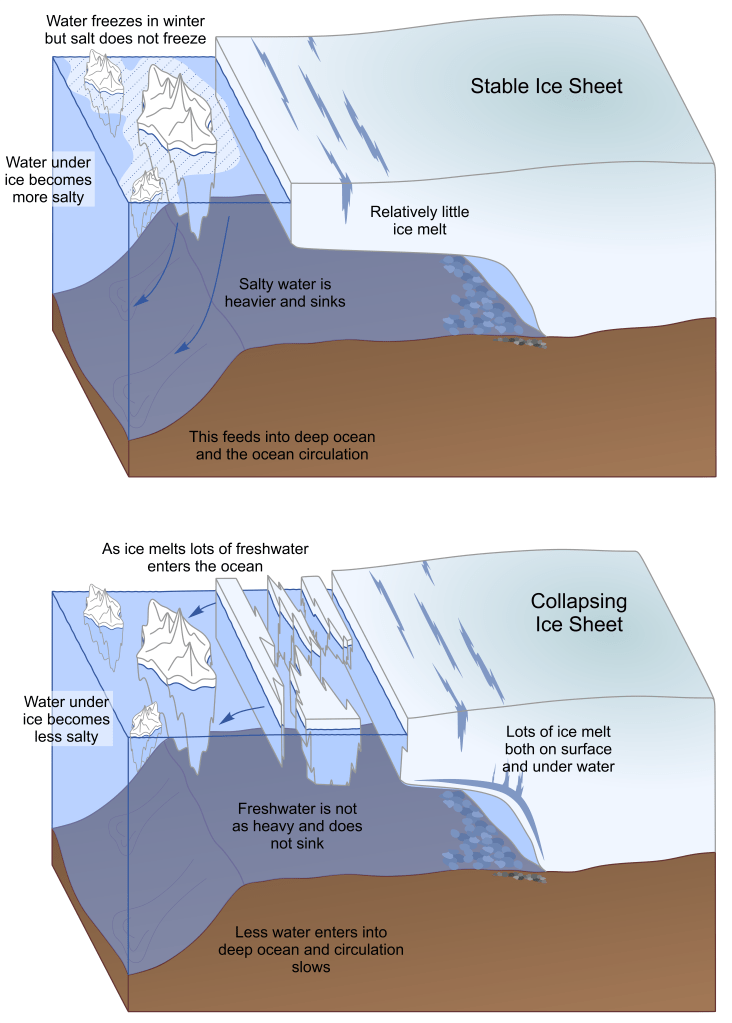
These low-probability but high-impact events will become more likely under higher warming scenarios. They could occur locally even if at a global scale impacts are in line with the IPCC models.
2. Our ability to adapt to climate change is limited by the amount of warming
The IPCC set 1.5˚C as our target for global warming because it would be possible for human society to adapt to this degree of warming. However, our ability to adapt is very much dependant on how much warming occurs.
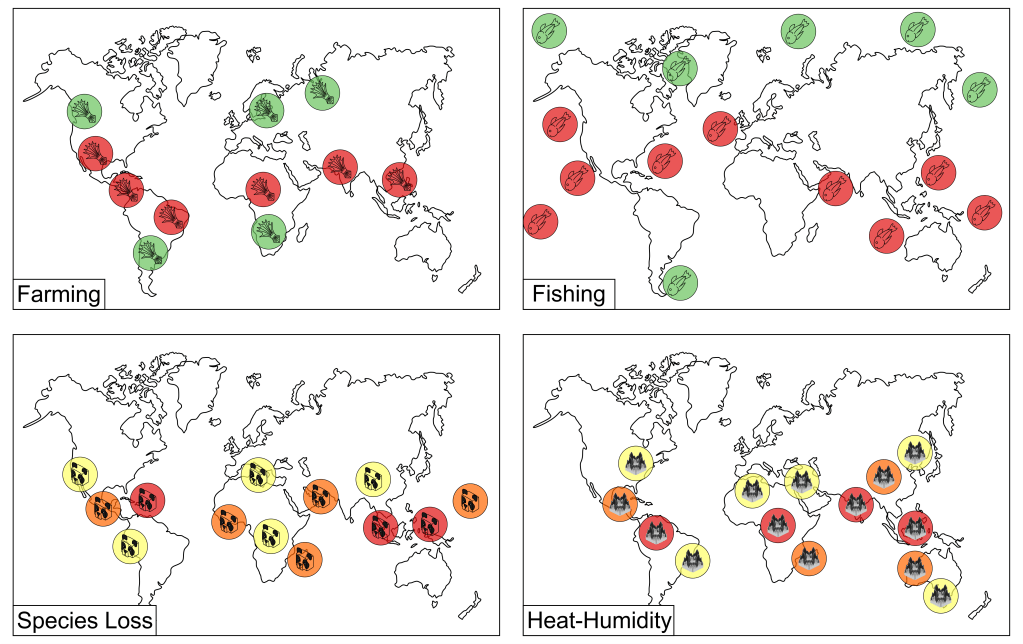
At 1.5˚C the agricultural sector can change where certain crops are grown, because while some areas become worse for farming, more areas will probably be better for farming. However, IPCC models indicate above 1.5˚C water scarcity and land degradation will occur across more and more regions. The amount of land seeing improvements in farming will be smaller than the land which is worse for crops. The IPCC stated that limits – i.e. decreasing land for farming – for major staple crops such as maize are likely to be reached at just 2˚C of warming.
This is true across many areas. Limits for forestry will be reached at 3˚C. There are limits for outdoor work due to heat stress that will be reached not much after 1.5˚C in warmer countries. Limits on freshwater and water management vary depending on location, with small islands and areas dependant on glacial melt reaching them first. However at 3˚C even Europe may start seeing their ability to adapt to water scarcity strongly limited.
The IPCC also warns that we must be wary of short-term, isolated attempts at adapting to climate change, because such projects can end up making matters worse at higher amounts of warming. Building a sea wall to counter sea level rise will work in the short term. However, sea walls are very expensive and have a physical upper limit on how much sea level rise they can cope with. At some point, if there is enough warming, they will fail. If no other methods to protect people from rising sea levels have been used, then a lot of money has been wasted and people are once again vulnerable to climate change effects.
It is better, the IPCC report, to work on integrated, long-term planning, especially ones that are based in sustainable development. If adaptations are planned well ahead, combining multiple solutions and include local community engagement then they are much more likely to work even at higher levels of warming.
3. We have a limited carbon budget left to keep to 1.5˚C
Keeping warming to 1.5˚C avoids the worst impacts of climate change and means we are able to adapt to the changes that have already taken place. However, to do this, there is a limit to the emissions we can release into the atmosphere.
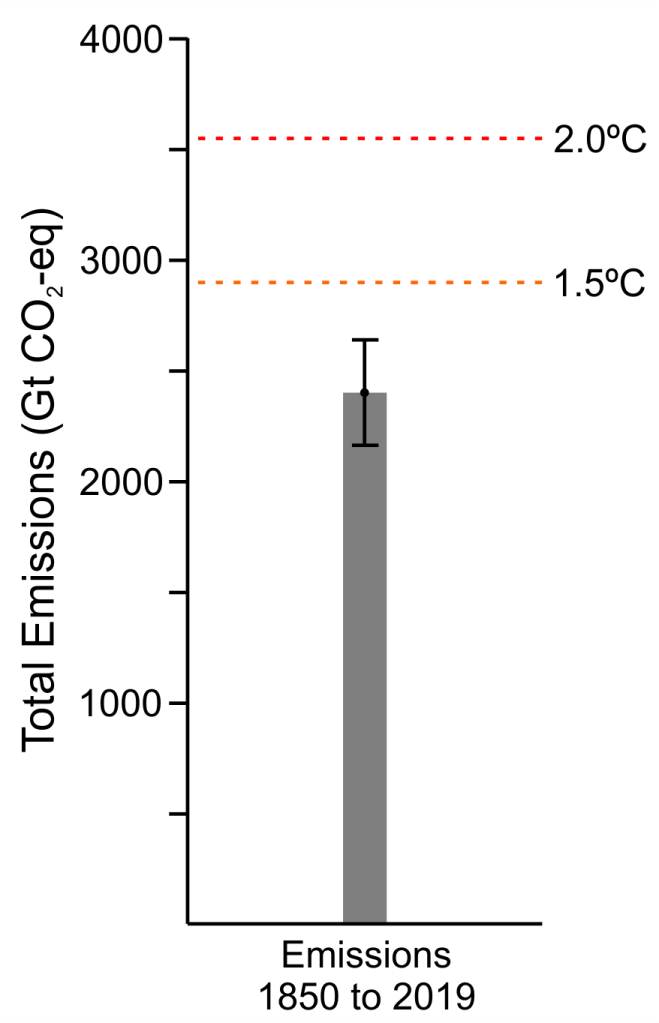
The way the IPCC calculates this is using a carbon budget. This is the amount of carbon dioxide, or the equivalent amount of non-CO2 greenhouse gases, we can release to keep warming to a certain level. The approximate amount of total emissions to bring the global temperature from the 1850-1900 average to 1.5˚C above the average is 2900 Gt CO2-eq (giga-tonnes of carbon dioxide equivalent). As of 2020 historical total emissions reached around 2400 Gt CO2-eq. That means we have used four fifths of the total carbon budget.
At current rates of emissions – about 59 Gt CO2-eq per year – by 2030 we will have used up almost the entire carbon budget.
For 2˚C of warming, it isn’t much better. We’ve used up about two thirds of the total budget and, if we maintain current emissions, we’ll use about one third of what is left by 2030. Some of this is offset by natural land and ocean sinks, which absorb CO2 and other greenhouse gases from the atmosphere. Yet, while they will continue to absorb more and more carbon even at higher emissions rates, this will become proportionally less and less.
Some sinks, such as permafrost and wetlands, are affected by warming. If we lose significant areas of wetland and large parts of the permafrost thaw, as the models project under higher levels of warming, those sinks will reverse and start to release emissions themselves. This will use up even more of the remaining carbon budget.
If we exceed the carbon budget, then the consequence is greater overall warming. To prevent this, we need rapid, sustained and significant reductions in both CO2 and non-CO2 greenhouse gas emissions.
4. The timing of net-zero is key to warming
Net-zero is something that is becoming increasingly well heard in climate debate and outreach, but there are actually two types of net-zero that the IPCC describes.
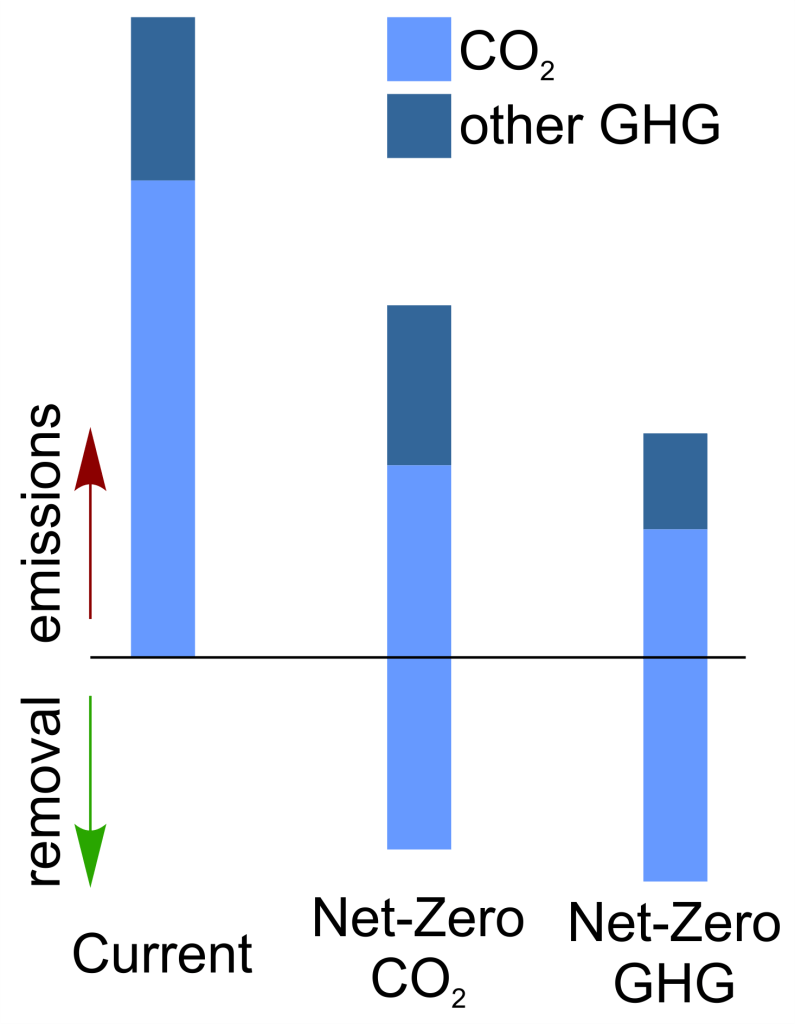
The first is net-zero CO2. This means that overall we are not releasing anymore CO2 into the atmosphere. This doesn’t mean no CO2 emissions at all, but any emissions we make are counterbalanced by uptake from natural sinks or carbon removal projects. Net-zero CO2 is the first step in keeping warming in check and mitigating the worst of climate change.
The second is net-zero greenhouse gases. Overall the emissions of all greenhouse gases, including CO2 and methane, are balanced by removal of those same gases from the atmosphere. This is the ideal point at which we need to reach and will, according to the IPCC, have a gradual cooling effect if we manage to achieve it. However, as some greenhouse gas emissions, particularly methane, are difficult to reduce in significant quantities in order to achieve net-zero greenhouse gases we must have net-negative CO2.
We must be removing more CO2 from the atmosphere than we are releasing.
How fast we achieve each form of net-zero directly influences how much warming occurs. It also determines how fast we can reverse an overshoot. As 1.5˚C of warming is likely to be very difficult at this stage, the IPCC discuss the possibility of an overshoot to 2˚C in the middle of this century, but then lowering it back down to 1.5˚C by 2100. We can only achieve this by getting to net-zero greenhouse gases, because this will have a modest cooling effect.
This makes removing carbon from the atmosphere necessary. There are now lots of ways to remove carbon from the atmosphere. There are sustainable developments, like restoring wetlands, improved forest management and reforestation, as well as technology-driven options like carbon capture and storage. They all have different costs and benefits and work on different timescales and we’re likely to need a combination of them all. However, we cannot use carbon removal as an excuse to continue burning fossil fuels at the same rates as now. That might get us to net-zero CO2 emissions, but holds us back from net-zero greenhouse gases. If we overshoot the 1.5˚C target, as seems likely, we have to get it back down as fast as possible. The longer the overshoot lasts and the bigger the overshoot is, the worse the impacts. Some of those impacts will be reversed if we do manage to get back to 1.5˚C, but it risks reaching one of the tipping points previously mentioned.
5. Sustainable development, mitigation and adaptation are interlinked
There is a lot to do. In the energy sector alone, the IPCC expect that all electricity must come from zero or low carbon courses by 2050 alongside electrifying large parts of our infrastructure that currently use fossil fuels (i.e. cars and other transport, gas boilers and stoves in homes). However, many people and governments balk at the massive changes that need to be made in a short space of time.
It doesn’t need to be all bad news, however.
The IPCC discuss the possibility to link together climate change mitigation and adaptation to sustainable development. In doing this, the changes that need to be made will have benefits for human populations beyond dealing with climate change.
An example the IPCC uses is in using sustainable land management in conjunction with pushing for changed behaviours from people in regards to food. This means making certain dietary choices, reducing post-harvest losses and reducing food waste. Sustainable land management means improved biodiversity and cleaner water resources, while reducing food waste and changing our diets reduces poverty and hunger while promoting better health and wellbeing.
This isn’t a magic bullet. Sustainable farming and eating different foods alone isn’t going to solve all the issues of greenhouse gas emissions in agriculture. It isn’t all positive either; changing diets to eat certain food more can also lead to more intense farming of those crops which is often bad for biodiversity and water quality. However, the IPCC indicate that careful management with focus on sustainability would result in overall positive effects both for the climate and human society.
To quote the IPCC:
“Modelled pathways that assume using resources more efficiently or shift global development towards sustainability include fewer challenges, such as dependence on [carbon removal].”
IPCC Synthesis Report, 2023
These combined mitigation, adaptation and sustainability plans aren’t even that much more expensive, if put in the context of the cost of not adapting to climate change. The IPCC estimates that the overall costs of mitigating and adapting to climate change are only a fraction compared to how much global GDP is expected to grow over the coming years.
The longer we put off the changes needed to mitigate and adapt to climate change, the greater the cost from damages caused by climate change. At this stage, the IPCC has medium confidence that it will cost less to keep global warming below 2˚C through mitigation than it will to allow warming to exceed 2˚C. In addition, sustainable options will become less and less effective with more warming and we will have to rely more on options that harm the planet in a different way.
The Takeaway
Part one of the IPCC report ended with a clear message that there was hope, but it required immediate, drastic action.
Part two has a similar message. We cannot afford to wait any longer, because the consequences will be drastic and even worse than we have previously projected. However, the changes that we need to make aren’t bad. If we act now and act quickly, we can focus on sustainable development which not only gives us more flexibility in projects, but has long-term benefits for us beyond climate change.
It won’t be easy, but we will be better off in the end. The final part of the IPCC report, “Near-term responses in a changing climate”, goes into more detail on what we can do in the short-term to make this a possibility.

 Rivers of Ice
Leave a comment