
Everyone knows something about carbon dioxide (CO2). CO2 has been the watchword of the climate debate since it started, for good reason. However, it seems even in 2023 it is still being misunderstood or weaponised. That isn’t a surprise. The science behind CO2 and other greenhouse gases is complicated and new data is constantly being added.
Yet, you don’t need to be a climate expert with a PhD in atmospheric science or thermodynamics to understand the role of CO2. The story of CO2 and climate has been written into Earth’s history. For a non-scientist, looking at this history can teach so much without the complicated equations.
Understanding natural climate change
Earth’s climate is always changing. There have been times in the past where Antarctica was covered by a sub-tropical rainforest, or when a large percentage of the planet was covered entirely by ice.
We know this because pieces of those climates are preserved in rocks. The climate decides what kind of animals and plants live in any given area. Those living things, when they die, are buried by soil or sand. Over time that soil or sand becomes rock and the remains of those animals and plants are preserved, ready to be dug up and studied by scientists.
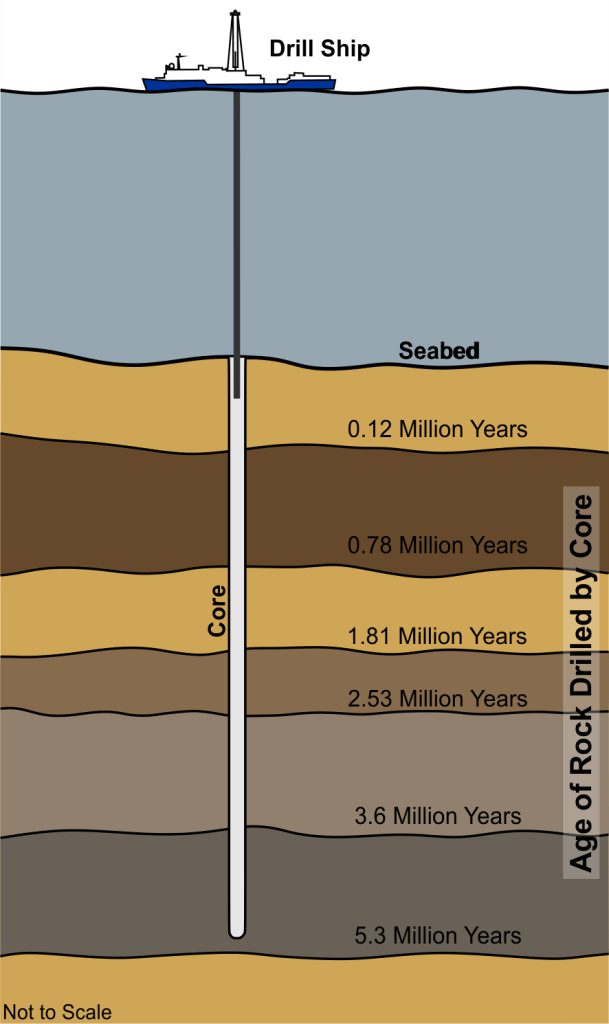
While there are lots of different rocks and living things that scientists can study, some will give more information on the climate than others. One of the best is when scientists drill directly down into the seabed and collect a long tube of rock called a core. The longer the core, the further back in history scientists can look.
These cores contain tiny fossilised sea creatures, similar to modern day plankton. The minerals that make up the fossil tell scientists about the temperature when the creature was alive. A full core can contain thousands of these creatures, living at different times. All put together, scientists create a timeline of changing temperature.
One of the most famous records from these cores was made in 2005 by Lorraine Lisiecki and Maureen Raymo. They used 57 cores from across the whole planet to make a complete timeline of global temperature for the last 5.3 million years.
From this record we can see that climate naturally forms a pattern of warm periods and cold periods, with the global temperature shifting between the two. The cold periods are called glacials, or ice ages, while the warm periods are interglacials. These glacial/interglacial cycles have been going on for the last 5 million years, and perhaps even before that.
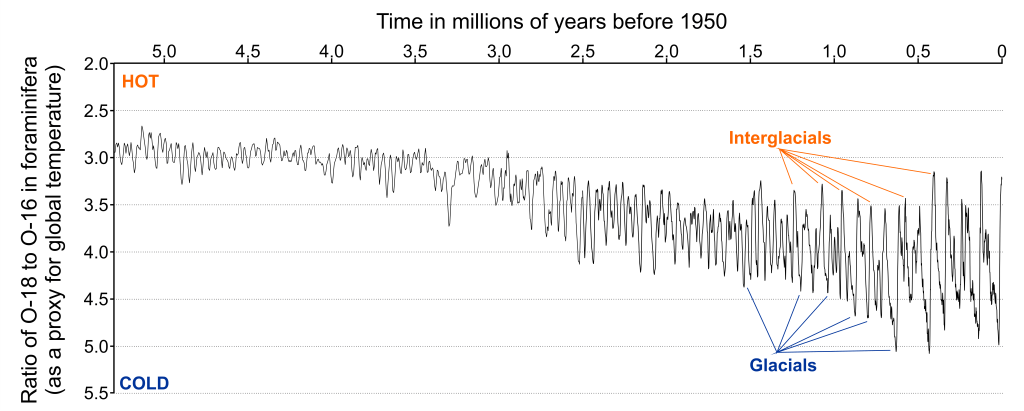
Currently we are in an interglacial or warm period. It started about 12 thousand years ago. The last interglacial before this one ended about 115 thousand years ago.
On top of this record we can add the CO2 levels from the last 1 million years, which scientists can measure from polar ice. This shows that whenever global temperature changes dramatically, so do the CO2 levels in the atmosphere. Usually, in fact, the change in CO2 levels happens before the change in global temperatures.
When CO2 starts to rise, so do global temperatures. When global temperatures start to fall, CO2 levels are already falling.
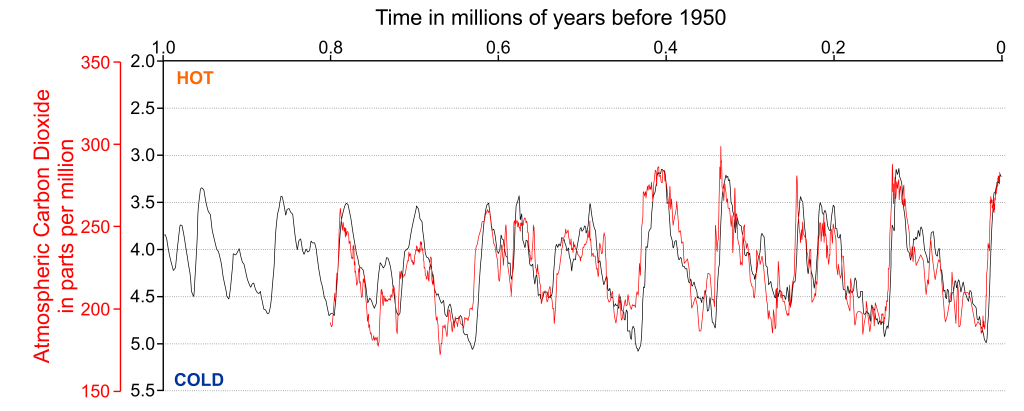
This climate record shows that CO2 has a big role in natural climate change. It is not the only thing that controls the glacial-interglacial cycle, however, without CO2 those cycles simply wouldn’t exist. The reason for this is the same as the reason why, without CO2, our planet would not be able to support life at all.
CO2 is a natural insulator
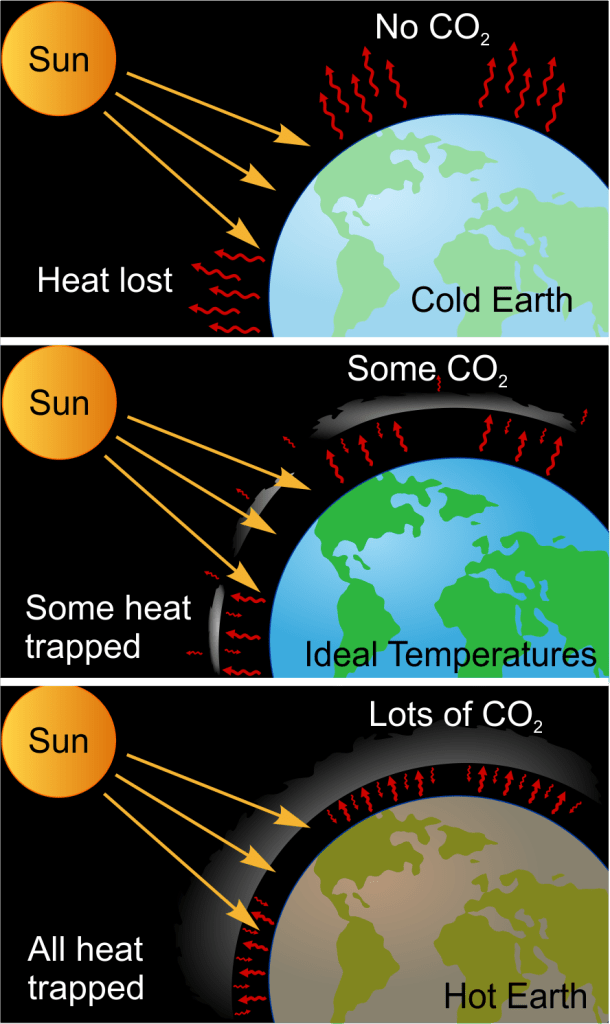
In very simple terms, CO2 works the same way as insulation in a house during winter. The house is warm; the air outside the house is cold. Heat tries to move from the warmer area to the colder area. Insulation traps the heat and keeps the house warm.
The Earth is heated by light and radiation from the sun. That heat tries to escape into the freezing cold of space, but it is trapped in the atmosphere by CO2 and other so-called greenhouse gases. Without the greenhouse gases, the heat transferred from the sun to the Earth would immediately disappear into space.
A warm planet allows for liquid water to exist naturally. Our climate is also driven almost entirely by temperature and air pressure. Without CO2 trapping heat all water on the planet would be ice and the climate would be reduced to dry winds. This would make supporting complicated living things, like plants and humans, impossible.
However, as much as CO2 and greenhouses gases allow us to survive, it is also true that you can have too much of a good thing.
House insulation in cold winters is important. It helps keep houses warm and saves energy on heating systems. However, as anyone with an insulated house knows, it becomes miserable in the middle of a summer heatwave. This is the same with the planet’s natural insulation.
The amount of insulation CO2 and other greenhouses provide is directly proportional to how much of the atmosphere is made up of those gases. In short: the more greenhouse gases there are, the hotter the planet becomes.
Core records currently only go back about 5.3 million years. However, we can work out global temperature and CO2 levels before that using other types of rocks. The difference is that these rocks don’t make a complete timeline the way a core does. They are fragments from different times and places.
It’s like the difference between a few photographs taken every few hours to a full video recording of the day. With enough photographs you can build the timeline up, but it is much more difficult. If you didn’t record the time when the photograph was taken, it’s even more difficult.
Still, scientists have a lot of ‘photographs’ and they’ve been working very hard to get the dates right. They have worked out the most likely timeline of global temperature and CO2 levels as far back as 540 million years ago.
This record says that the hottest the Earth has ever been in those 540 million years was about 50 million years ago, during the Eocene period. During the Eocene, global temperatures were about 10˚C higher than modern temperatures. At the same time, CO2 levels were estimated to be three times the current levels.
CO2 levels are rising far too fast
Alright. CO2 is a natural insulator we cannot live without and the planet has been hotter before, with more CO2. What does that mean for modern day climate change then? Surely, if these things are true, it can’t be such a big deal?
Well, in truth, when it comes to modern day climate change it is not only how high global temperatures will get, despite what the news will tell you. Arguably how fast global temperatures are rising is far more important. During the Eocene, CO2 and global temperatures increased gradually, over the course of tens of thousands of years. Habitats adapted, animals and plants evolved or migrated to find somewhere more suited to them.
Remember, scientists have a record of not just how much global temperatures have changed over the last 5.3 million years, but also how fast.
Scientists believe that the fastest natural change in global temperatures takes place as the world goes from a glacial to an interglacial. From cold to warm. During the last time the climate did this, between 20-12 thousand years ago, global temperatures rose about 1.5˚C per 1000 years. That is about 0.015˚C per decade.
Currently, global temperatures are rising at about 0.18˚C per decade. That is 10 times faster than the fastest natural climate change.
Plants and animals are not going to be able to change fast enough. They are going to be trapped in an insulated house during the worst heatwave in existence. Even humans, with our ability to build new technology to try and cope with the heat, are going to struggle if we don’t find a way to get rid of all that insulation. Or at least stop installing it and making the problem worse.
Rising CO2 levels are not natural
The fact that global temperatures are rising 10 times faster than the fastest natural change makes it clear that something has changed in the natural cycle.
However, if that isn’t enough proof, we can also look again at the glacial-interglacial cycles and what they tell us. For the last 800 thousand years the glacial-interglacial cycle has occurred on a very regular pattern. From interglacial to glacial to interglacial (warm to cold and back to warm), it takes about 100 thousand years.
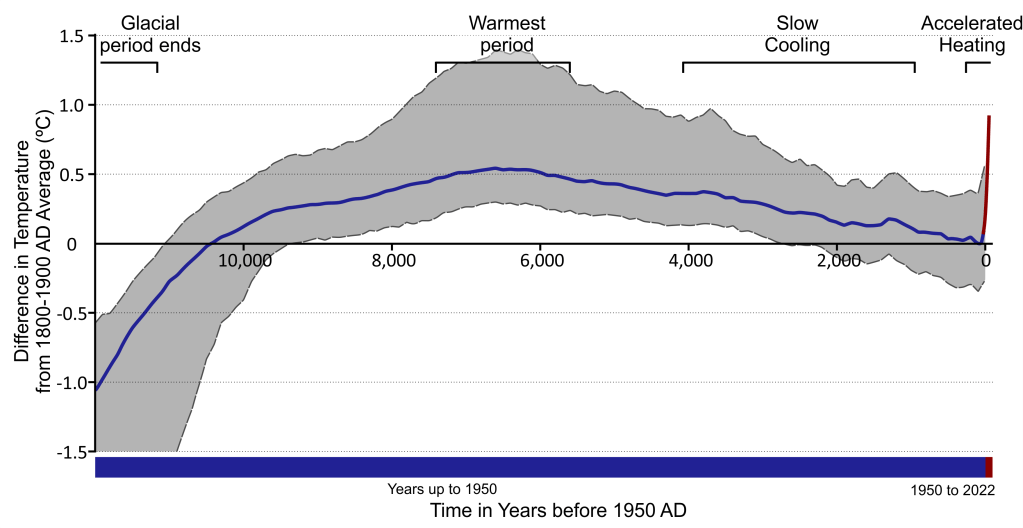
The last interglacial ended 115 thousand years ago. If the natural cycle were to continue, without interruption, then the Earth is due to start a new ice age very soon. In fact it had already begun. Global temperatures reached their warmest for this interglacial about 8-6 thousand years ago. Since then, the planet had been cooling right up until the 20th century.
From the 20th century onwards, the global temperatures have been rising faster and faster. The complete opposite to what history tells us it should be doing.
What, then, has changed?
What is different about this warm period in Earth’s history that was not true before the last ice age? In short: humans.
Humans have radically changed the natural world around them. Habitat loss caused by humans has led to the extinction of many plant and animal species. We have cut down forests to build cities and skyscrapers. Human pollution harms us as much as it harms the environment.
Occam’s Razor states that the simplest explanation is the most likely answer. Of course, it is possible to create theories as to what natural processes are causing modern climate change. The theories though are all very complicated and usually mean ignoring at least some of the data scientists have been collecting for decades.
Far more likely the answer lies with the species that is now pumping out millions of tonnes of a very powerful insulator into the atmosphere each year. It is the simplest explanation and it is backed up by decades of study by thousands of scientists across the world.
CO2 is only part of the problem.
The question of whether or not CO2 has been demonized by the media depends very much on your perspective.
CO2 is crucial to the world as we know it. Without it, we wouldn’t be here to worry about whether it is good or bad. In this respect, rising CO2 levels alone isn’t an issue. The planet will adapt eventually and those plants and animals that can’t keep up will be replaced.
What is a problem is how fast CO2 levels are rising and, thus, how fast global temperatures are rising. The natural cycle of the last 5.3 million years has been broken. Instead of going into another glacial period, we are rocketing up into another Eocene period. The climate is changing too much, too fast and we don’t know if humanity can keep up, let alone all the species and habitats that we rely on.
This is not the fault of CO2. CO2 is just doing what it has always done.
The fault lies, as scientists have been trying to tell us for decades now, with humanity. We are the ones pumping more CO2 into the atmosphere than we can adapt to. We are the ones who broke the natural cycle.
We are also the only ones who can stop it. To do that, though, we need to stop deliberately misunderstanding or weaponising the science. Climate change isn’t a debate anymore, it’s just a fact.


 Rivers of Ice
Leave a reply to The landscape is more than just beautiful; it’s also a useful scientific tool – Rivers of Ice Cancel reply