
Global warming is China’s problem to fix. Their contributions to carbon dioxide emissions vastly outweigh anyone else’s. Even if the rest of the world de-carbonises, it won’t mean anything because China is building a new coal-powered power station every week.
If any of these arguments seem familiar, it is for a reason. It has become an increasingly common refrain since China overtook the US as the highest emitter of greenhouse gases. Often it goes hand in hand with how moving towards a low-emission society will devastate the economy. There is some truth to it. China is the biggest emitter of greenhouse gases and has been for a while. Transitioning to low-emission society is not going to come easily.
Yet, is global warming and climate change really ‘China’s issue’? Is there really no point in the west doing anything about our climate? Well, let’s look at the facts that we do know.
China produces more emissions than anyone else
According to the International Panel for Climate Change (IPCC), Eastern Asia contributed 27% of the total of 59 GtCO2equivalent emissions in 2019. This includes China, North and South Korea and Mongolia. After East Asia, the next biggest emitter is North America, consisting of the US and Canada, at 12% of the total emissions in 2019.
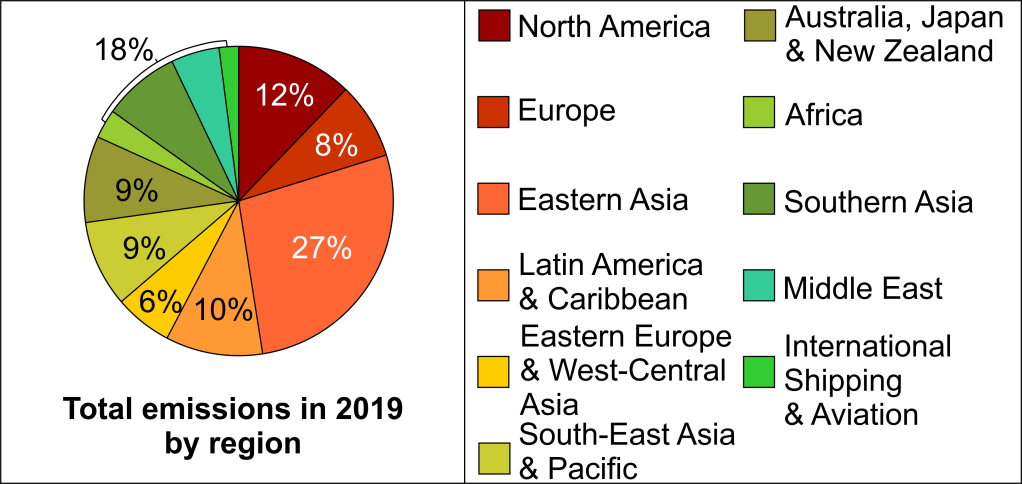
This is not the full story, however.
We know that countries with a higher population tend to produce more emissions, as there are more people in need of power and food and the vast majority of emissions still come from power generation and food production. China is the second most populous country in the world, the US is the third.
If we want to blame any country for being ‘the problem’ when it comes to emissions, surely, we need to see which countries are producing more than their fair share of emissions, based on their population? Most emissions are bad for our climate, but if one country is producing more than everyone else, that isn’t fair, right?
Well, the IPCC has provided that data. Looking at emissions per capita – that is emission per person – for each of the major regions then North America comes out well ahead of all the others with 19 tonnes of CO2-equivalent per person, or about 19% of total emissions when population is taken into account. Eastern Asia, despite including China, comes fifth when ranked according to population after Eastern Europe, the Middle East and the combined group of Australia, Japan and New Zealand.
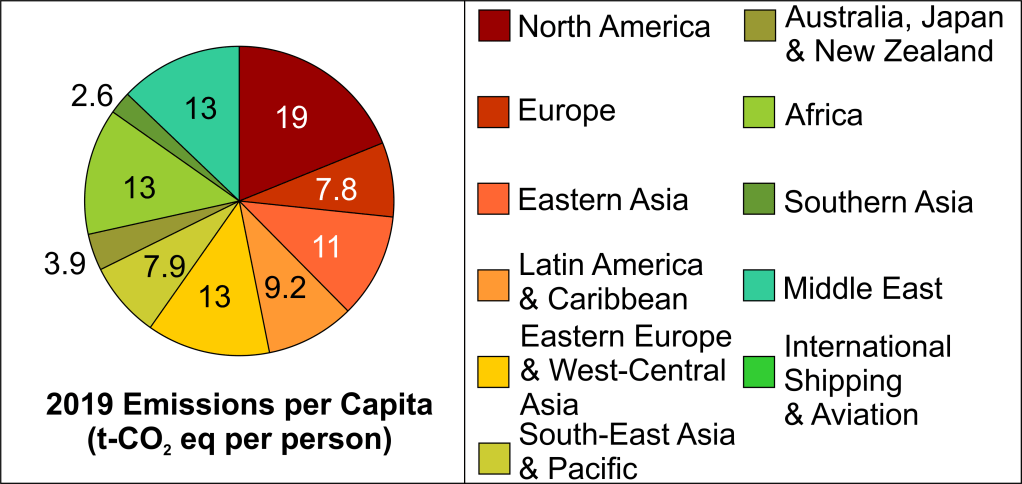
It’s also important not to forget the historical contribution of different countries. Carbon dioxide stays in the atmosphere for anywhere between 300 and 1000 years, depending on climate conditions. The emissions released during the first half of the 20th century are still in the atmosphere and still contributing to current global warming. The early part of the 20th century is when emissions started to rise drastically, leading to today’s situation. Thus, to be fair, we must look at all contributions and not just the contributions of a single year.
The IPCC has reasonably good estimates of the total emissions of carbon dioxide from 1850-2019, though less certain estimates for other greenhouse gases. They report that of total carbon dioxide emissions over the last century, the US contributed 23% of them, followed by Europe with 16% of all emissions. East Asia, including China, is catching up to Europe at 12%, but is still not the worst offender.
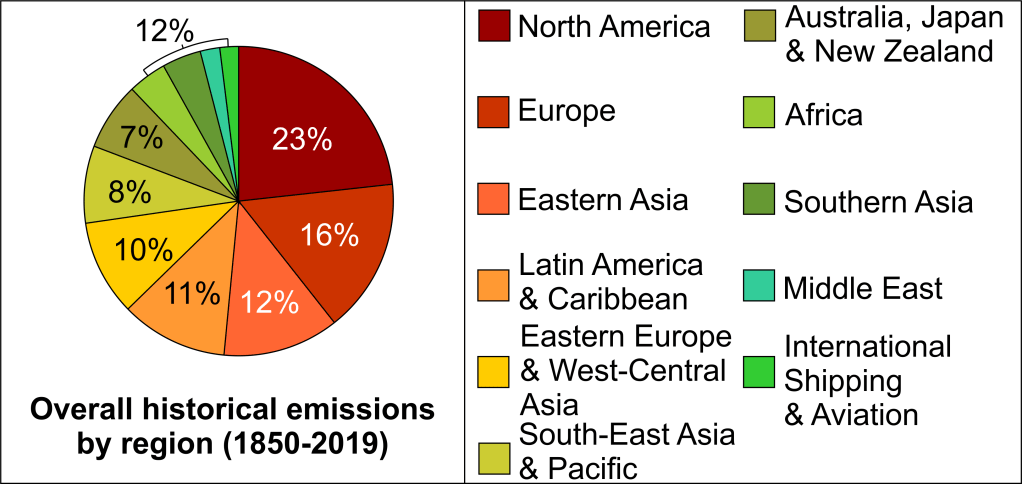
In short: China might have the highest total emissions right now, but it is far from the worst offender historically. Nor is it the worst offender when population size is considered.
There’s no point in cutting emissions if China keeps building more power stations
We can see clearly from the numbers in the previous section that this is simply not true.
The IPCC state we need to halve current emissions within the next decade and reach Net Zero carbon dioxide by around 2050 if we want to avoid warming greater than 1.5°C above the pre-industrial average. The total emissions for the year of 2019 were found to be approximately 59 Gt-CO2 equivalent – half of that is about 30 Gt-CO2 equivalent. This is our goal for 2030. For 2050, we need to be looking at emissions closer to around 10-12 Gt-CO2equivalent.
To put it simply – China contributed 26% of that 59 Gt-CO2 equivalent. If China reaches Net-Zero by 2050 and all other countries continue as they are – no reductions and no increases – the total yearly emissions will drop to around 43 Gt-CO2 equivalent. That is nowhere near even the target we’re supposed to meet by 2030.
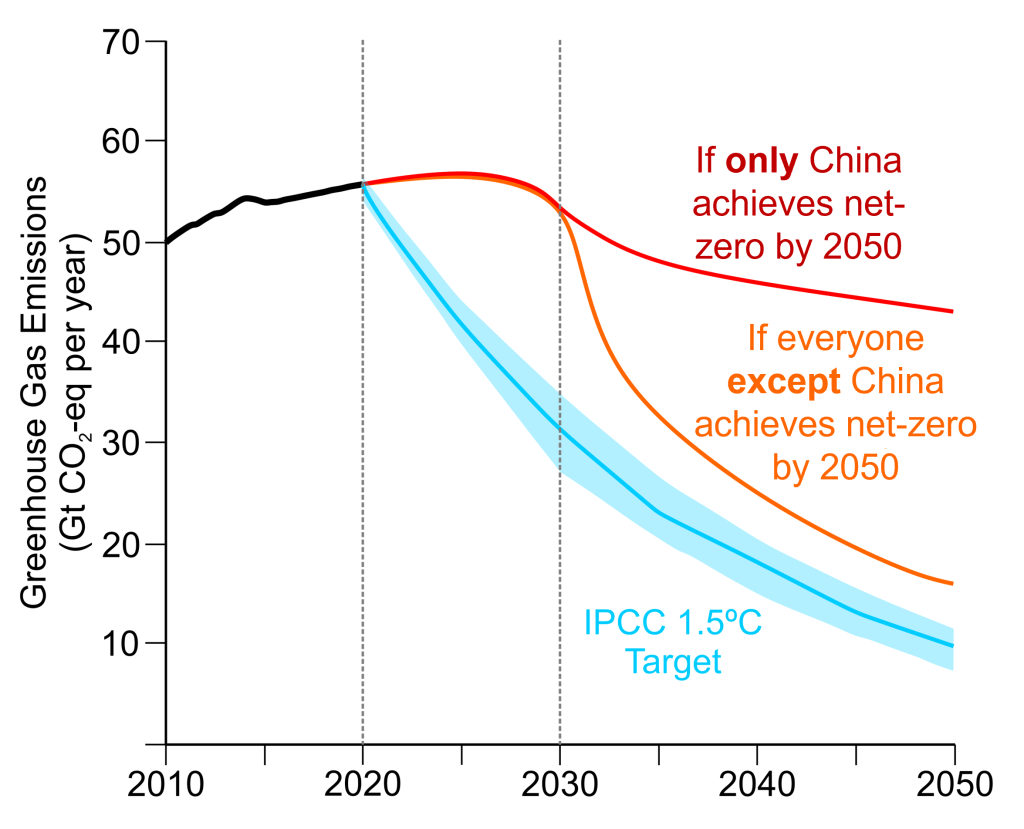
Conversely, if every country except China reaches Net-Zero by 2050, while China continues as it is, overall emissions will drop to around 16 Gt-CO2 equivalent. This is almost completely on target for 1.5°C and certainly will help us avoid some of the worst consequences of climate change.
Obviously, this assumes that China doesn’t increase its emissions while all other countries are reaching Net-Zero. However, China is not the only country whose greenhouse gas emissions are still increasing, year-on-year. Most of the biggest contributors to greenhouse gas emissions are also still increasing their emissions year-on-year.
China isn’t doing anything to reduce emissions
China is currently heavily reliant on coal power generation. Coal is the worst of all the fossil fuels when it comes to releasing carbon dioxide and other greenhouse gases. This is because the hydrocarbons in coal – the compounds that are burnt to produce energy and which release carbon dioxide when burnt – are much longer than in oil or gas. Longer hydrocarbons contain more carbon and thus produce more carbon dioxide when burnt.
The reason China uses coal so extensively, is because they have vast reserves of coal and it is much cheaper for them to mine than it is for them to extract oil and gas. With such a large population in need of power, it has traditionally opted for the cheapest and most reliable source, regardless of the environmental cost.
However, that does not mean that China is not also heavily investing in renewable sources of energy. A report by the Global Energy Monitor published in June 2023 has shown that China may well be leading the way in large-scale renewable energy projects.
According to GEM, both the solar power generation and wind power generation in China has increased in the region of 200% in the last ten years. Their solar capacity now sits at around 228 giga watts (GW) – more than the rest of the world combined. Their combined offshore and onshore wind power capacity is around 310 GW. This capacity is expected to double by 2030.
On June 25th 2023, the world’s largest solar-hydro power station started to operate on the Tibetan Plateau. The combination of solar and hydropower covers the weaknesses of each type of power generation – solar’s inconsistent generation and hydro’s inability to adapt on short time scales to demand – and will generate enough power for 700,000 households annually.
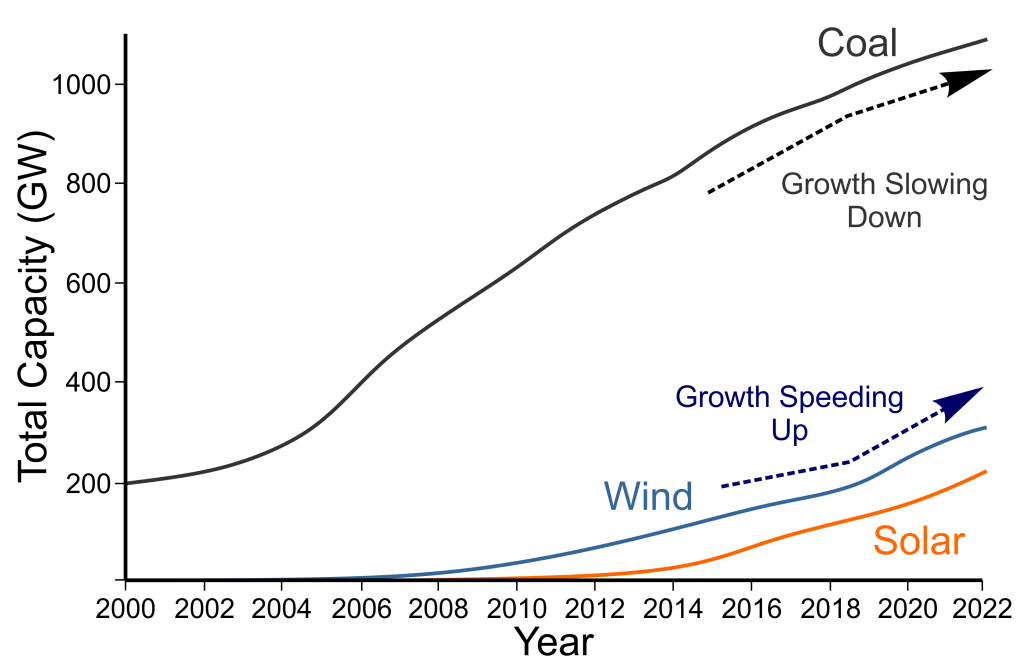
China’s target is to reach peak emissions by 2030 and Net-Zero before 2060. Although this is not quite as ambitious as, for example, the US’s commitment to reducing all emissions by 50-52% by 2030 and net-zero by 2050. The truth is that China is well on track to meet their target and to meet it early – unlike the US.
The reason why China is doing so well with renewables is that starting around 15 years ago the Chinese government heavily invested and subsidised research into renewables. China is the biggest reason why the price of solar has dropped to the point where it is now on par with the price of fossil fuels. They dominate the market when it comes to building solar panels, and have a large stake in the market for parts for wind turbines. As such they benefit more from cheaper production costs than everyone else, as well as receiving the centralised funding that really allows for the renewable energy sector to grow.
Now 15 years might seem like a long time ago and some people might wonder why China invested so heavily into renewables so early. Part of that was China was facing an energy crisis with not enough energy for their population. However, they could have continued to invest in cheaper fossil fuels. Notably, however, 15 years ago was 2008 – the year after the International Panel for Climate Change won the Nobel Peace Prize for their report warning about the dangers of climate change.
China heeded the warning and started to actively invest in renewables. It took western countries until the Paris Agreement in 2015 to do the same and even now, their financial investment falls far short of the goals set.
China is the bad guy
Of course, China might be making great strides in renewables, but they are far from the perfect. China is still building new coal power plants and their environmental credentials in other areas are lacking. They aren’t exactly world leaders when it comes to the environmental impact of their vast mining operations for both coal and rare earth minerals. That’s even before we get onto the humanitarian issues the Chinese government continue to deny, despite the plentiful evidence of atrocities enacted on ethnic minorities. This article is not meant as a defence of the Chinese government.
It is important, however, to recognise that casting China as the ‘bad guy’ in the climate debate isn’t really about China itself. It’s about pushing away blame and western countries refusing to take responsibility for their actions.
Global warming and climate change is not a ‘Chinese problem’. Pretending that what the west does is irrelevant, because China will continue to do whatever it wants and what it wants is to build more coal-powered power stations, is not helpful. It’s just an excuse to do nothing.
China currently has the highest emissions of any country. Yet, if current trends continue, with China investing heavily into decarbonising while the West blames China and does almost nothing – that won’t last. This isn’t a movie; it isn’t a black and white issue with one ‘bad guy’ ruining things for everyone else. We are all responsible and we all need to work on fixing the problem. The best-case scenario is when everyone achieves net-zero as soon as possible and certainly by 2050.
 Rivers of Ice
Leave a comment