
The 6th synthesis report from the International Panel of Climate Change has a strong message of urgent action, dire warnings and hope. The first part of the report, summarised here, looked at where we are right now and how our climate has changed so far due to human action. The second part of the report, summarised here, looked at where we may end up depending on the choices we make here and now.
The third and final part of the report, ‘Near-Term Responses in a Changing Climate’ looks at what those choices we have are.
This is, perhaps, the most important part of the entire summary report. With so many dire warnings of what our future holds, people want to know what we can do. They want to know what we must do to avoid the oncoming disaster.
What does the IPCC say then, about our actions now? Here are the five key takeaways from the third part of their summary report.
1. Climate change is going to continue for now
It is perhaps not a surprise, given how much our climate has already changed, that the IPCC expect the patterns already observed under climate change will continue for a while. Even if we halved global emissions tomorrow, the climate is still reacting to what we have already done to our atmosphere.
These effects are likely to be complicated, with far ranging knock-on impacts. For instance, an increasing number of heatwaves and droughts will lead to decreased soil quality, decreased food production, and a decreased ability to work. These will, in turn, lead to higher food costs, lower food security and lower income for many.

However, the degree to which these effects will impact us in the near term will depend less on emissions and more on how vulnerable any given region and community is.
An example the IPCC gives is population distribution. More and more people are living in cities and this trend is set to continue in the near future. Cities are prone to more extremes of heat, they reduce how much water is absorbed by the ground during rain and increase the risks of flooding and they tend to trap air pollution having an effect on human health. As more people start living in cities, more people will become vulnerable to extreme heatwave events even if heatwaves weren’t also becoming more common.
This is why the IPCC recommends choices which are more sustainable and focus on assisting more vulnerable populations as a priority. This not only has long-term goals for reducing emissions, but also has short-term effects in reducing the impact and damage of climate change that has already happened.
2. Rapid action is both good and bad
The IPCC is clear that we need drastic, rapid and sustained change in order to prevent the worst outcomes of climate change. They acknowledge that such massive change is ‘unprecedented in scale’ but the speed of it isn’t actually entirely unheard of. Rapid, international cooperation in the 1990’s saved the world’s ozone layer from aerosols that were damaging it. International cooperation fast tracked numerous vaccines to the covid-19 pandemic and likely saved millions of lives.
It isn’t that the changes needed won’t have bad outcomes in some cases, especially in some sectors. Jobs and economies reliant on fossil fuels will need to quickly diversify and switch to low-emission energy. Fossil fuel infrastructure is likely going to be abandoned at some point and represents a lot of money spent for little return.
At the same time, though, we know that this transition is coming. We can use low-emission development to create new opportunities and retrain people for new jobs. Fossil fuel infrastructure coming to the end of its life can be retrofitted for green purposes instead of replaced with more fossil fuel infrastructure. In this way, even the bad outcomes can be limited or turned to a benefit.
There are few specific examples in the IPCC report, as they state the exact pathways are very dependent on the country involved and their economic situation. That being said, the IPCC do point out that we have multiple cost-effective options for change that have positive benefits beyond climate change.
3. Our options are many and affordable
We have to reduce emissions across all sectors of the economy from manufacturing and energy, to infrastructure and consumption. We have the means to do this in the vast majority of cases and a lot of them are cost effective, especially in wealthier countries.
For example, light industry and manufacturing can largely cut emissions through improving material efficiency, electrification of their infrastructure and switching to low emission fuels such as hydrogen, biofuels or synthetic fuels. Even the most expensive of these options, which is switching fuels, is only up around 50-100 US dollars more expensive than the current option per tCO2-eq (tonne of carbon dioxide equivalent) reduction. Given the likely costs of climate change due to supply chain and operation problems in extreme weather, this seems like good value.
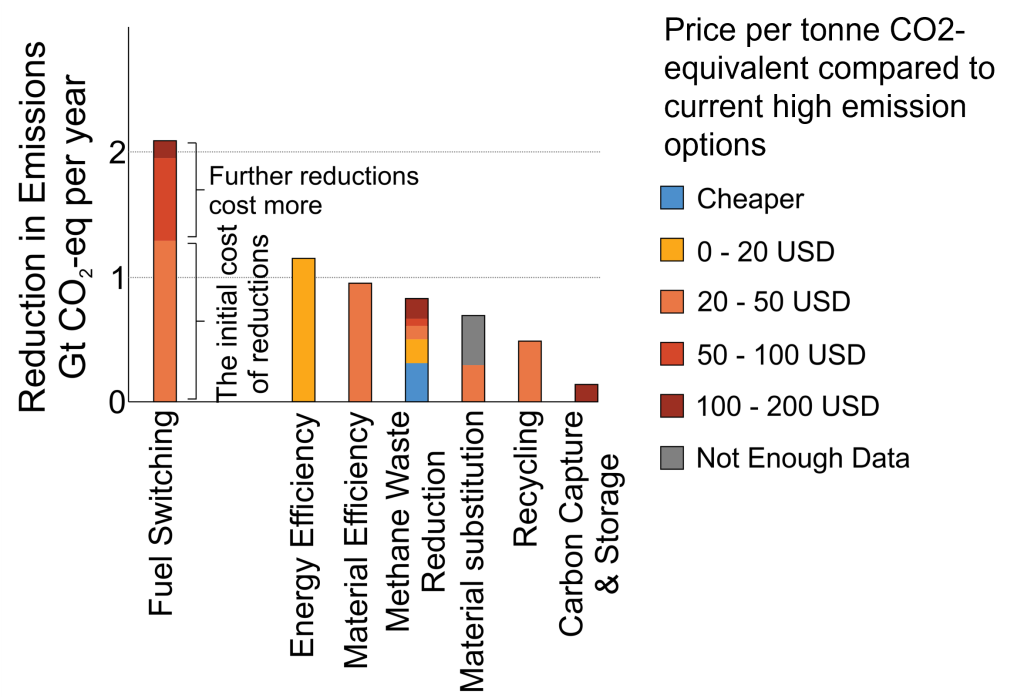
In cities, changing land planning and management while implementing widespread electrification and improving water and sanitation infrastructure can drastically reduce emissions while having knock on benefits for human health. Green and blue spaces within cities can have a cooling effect on the city itself; great for when those heatwaves start happening more often. They also help with preventing flooding, improving air quality and giving people spaces for exercise.
The IPCC report indicated that most of the mitigation options for city planning are actually cheaper than the current equivalent high-emission options. The ones that are not – such as widespread use of biofuels in public transport and onsite renewables – are likely to come down in price over time if they are more widely adopted.
The options are there, we just need to actually implement them.
4. Policy is the major driver of change
It is worth noting that all the policies the IPCC discuss rely on widespread change not individual action. The change needs to happen at all levels and across all sectors; both public governance and private industries. The only way to get this kind of wide-ranging action is through government policy.
Education and information programmes improve climate literacy and can lead to changing behaviour of consumers on a large scale, especially coupled with price incentives. An example of this can be the charge on single-use plastic bags which has seen a near elimination of them in the UK and a corresponding reduction in plastic waste in just a few years.
The private sector responds very well to clear policies that give guidance and framework for change, as well as pushes for more transparency and accountability. This is because it reduces risk and allows them to incorporate changes into their planning and budget cycles. Pushing through big changes without clear government support is not a risk most businesses are willing to take, especially if they anticipate policy changes in the future that might significantly affect the plans they have in place already.
The IPCC particularly highlights the need to reduce or eliminate subsidies for fossil fuels across many governments. Not only would this lead to a big push towards low-emission energy targets, it would allow for the public money currently spent on those subsidies to go elsewhere. Perhaps to the vulnerable communities that are at particular risk from the effects of climate change.
All these things are well within the reach of governments across the globe. Climate change policy might be limited in scope at the moment, but what has been implemented has led to reduced emissions. Now, these policies have to be scaled up and not just nationally.
5. International cooperation is necessary
Climate change doesn’t really care about human borders. A tropical storm isn’t going to stop at border control just because one country has reduced its emissions more than its neighbour. A drought in a country that exports a lot of food will drive up food prices across the rest of the globe. International cooperation, therefore, is as important as policy changes at a national level.
The IPCC state that international finance and cash flow are a huge part of the picture. The more access countries and businesses have to finance and investments to fund climate action, the better the outcomes for all of us. The countries expected to struggle the most when it comes to climate change are the poorest. Not only are they more vulnerable to climate change in general, they can’t afford to invest as much funding into adaptation and mitigation as wealthier countries.
The IPCC is certain that there is enough money to fight climate change across the globe, as long as that money is redirected to where it is most needed. However, so far this hasn’t happened. Part of the Paris Agreement included tracking cash flows relating to climate change action. The IPCC report shows that wealthier countries are not spending enough money to reach their own goals for climate action, let alone redirecting the money needed to help poorer countries meet theirs.
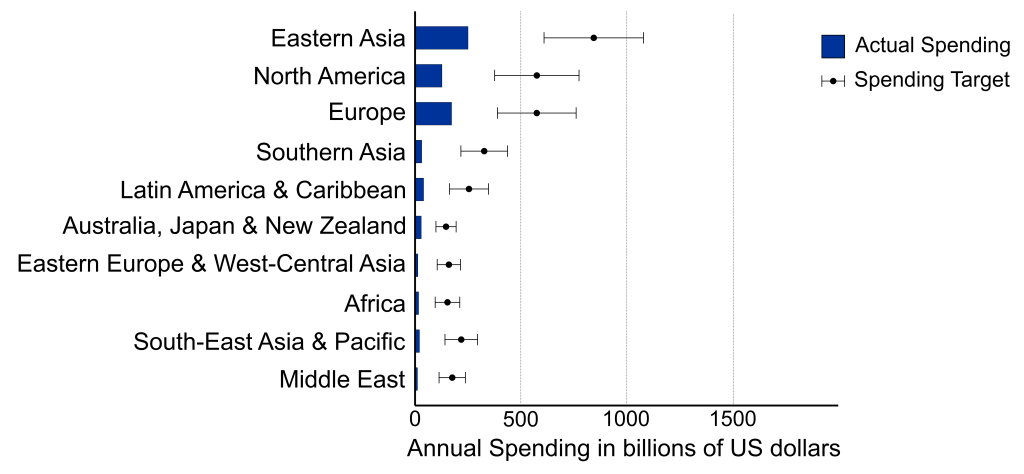
International agreements go beyond finance, however. More pressure can be put on multinational businesses to transition to low emission options by international agreement than by a single government alone. Advances in low emission technology and science have come about through teams of developers spread across the world and international agreements to fund and encourage science are a big part of that.
In short, we are all in this together and governments across the world need to do more to work with one another, to help those who are less able and to hold one another to account.
The Takeaway
The synthesis report of the International Panel for Climate Change’s sixth assessment is a difficult read. Not only because of how much information is densely packed within the 85 pages, but also because of the message it conveys. We are in a difficult position and only really have ourselves to blame.
We have to act now if we want to prevent catastrophic climate change. If we don’t, the damage to human society will be unimaginable. However, as bad as the situation is, there is still hope.
In the last decade, there is evidence of emissions slowing. Policies to reduce pollution and waste or to limit emissions have worked.
In the decades to come, if we miss our target goals, there are pathways to get back to them if we move from net-zero CO2 to net negative CO2.
For right now? This vitally important decade? We know what we have to do and we have multiple, feasible options that will help us achieve those targets, if we choose to act. If our governments choose to act.
 Rivers of Ice
Leave a comment